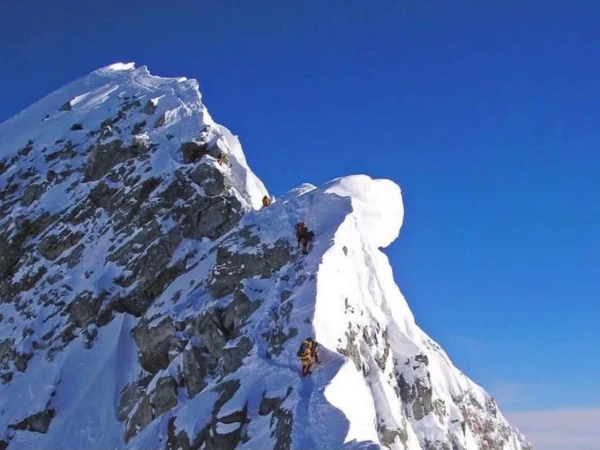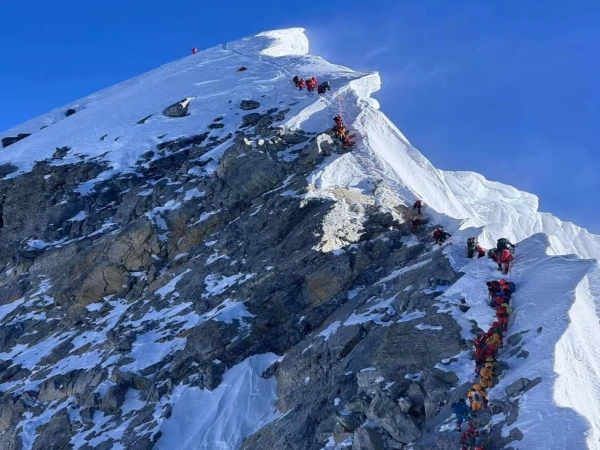
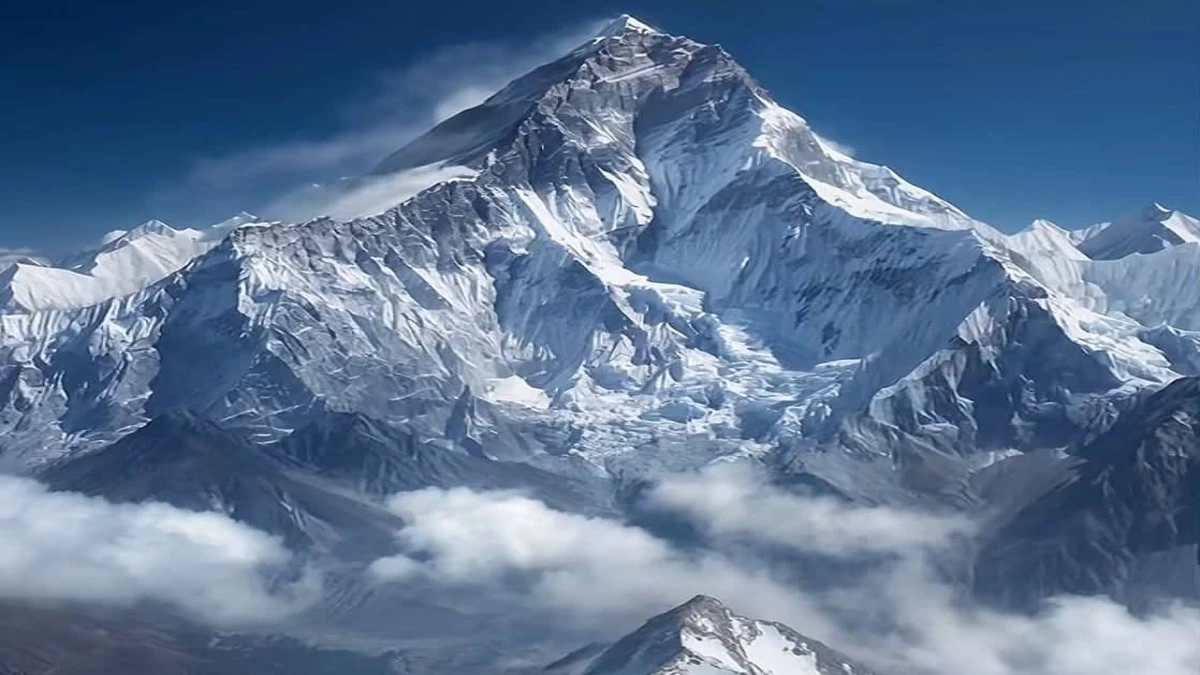

Have you ever wondered what's actually inside Mount Everest? You might think of Everest as a mountain covered in snow and ice. But no, it’s just the rock underneath all of it. And the surprising part is that rock was once part of an ocean floor.
Yes, the highest point on Earth used to sit underwater.
Mount Everest is located in the Solukhumbu district of Nepal, standing at 8,848.86 meters above sea level. But it wasn't always here, and it definitely wasn't always a mountain. The story of Mount Everest starts hundreds of millions of years ago, with a sea that no longer exists and rock that formed long before the Himalayas.
In this blog, we're going to walk through that whole story of how a seabed turned into the roof of the world. No heavy jargon, just the real science explained simply, the way we'd explain it to you on the trail.
Key Facts About Mount Everest
- Height: 8,848.86 meters (29,031.69 feet) above sea level
- Location: Solukhumbu District, Nepal, on the Nepal-Tibet border
- Nepalese name: Sagarmatha
- Tibetan name: Chomolungma
- Mountain range: Himalayas
- First confirmed ascent: Edmund Hillary and Tenzing Norgay, in 1953
- Age of the mountain: Around 50 million years old
- Age of the summit rock: Hundreds of millions of years old
- Rock type: Mainly limestone, marble, and other metamorphic rocks
- How it formed: The Indian Plate collided with the Eurasian Plate, pushing the Earth's crust upward.
- Interesting fact: Some rocks near Everest's summit contain fossils from ancient sea creatures, showing that the area was once part of the Tethys Sea.
Before Everest Existed: The Tethys Sea Beneath the Himalayas
Before there were the Himalayas, there was a sea. It's called the Tethys Sea, and it sat right where these mountains stand today. There were no peaks, no glaciers, no trekking trails, just open water, for a very, very long time.
What was the Tethys Sea?
The Tethys Sea sat between two landmasses. One later became India, the other became Asia. Back then, they were far apart, with all this water in between.
The sea itself was warm and shallow in many spots, much like the tropical waters near a coral reef today. For millions of years, small sea creatures lived and died there. Their shells and skeletons sank to the bottom, mixing with mud and sand, building up layer after layer on the seafloor.
Nobody was around to see it, of course. But this slow and quiet process was actually the first step in building Everest, long before the mountain itself existed.
How did marine sediments become the building blocks of Everest?
Here’s the surprising part: how did soft mud at the bottom of the sea turn into solid mountain rock?
The answer is time and pressure. As more and more sediment piled up on the Tethys sea floor, the older layers underneath got squeezed harder and harder. Slowly, the water got pushed out, and the soft material packed together and hardened into rock. Over time, this formed layers of rock, mainly limestone, along with some sandstone.
By the time this was done, the old seafloor had turned into thick beds of solid rock, full of fossils from all those tiny sea creatures. This rock had no idea what was coming next. It was about to become the highest point on Earth.
Even now, if you trek towardEverest Base Camp, you can spot fossils in the rocks along the trail. It's one of the clearest signs that this entire region was once sitting under the sea. But the sea couldn't stay still forever. Two continents were drifting toward each other, and that collision would change everything.
How the Himalayas and Mount Everest Rose from the Earth’s Crust
Once India and Eurasia collided, the Earth's crust was pushed upward. This is where the Himalayas actually started taking shape, rising slowly from layers of rock that were once part of the flat seafloor.
As India pushed into Eurasia, the Earth's crust was squeezed, folded, and pushed upward. Some rocks cracked along faults, forcing large blocks of rock higher. Layers that were once flat on the seafloor became tilted, folded, and even turned sideways.
This happened again and again over millions of years, slowly building the Himalayas higher.
How did Everest become the highest point on Earth?
So, why did one particular spot end up as the highest point on the planet?
A lot of it comes down to where the most pressure built up, and how the rock layers stacked on top of each other in that exact location. At Everest, several major faults pushed older rock up and over younger rock, creating thick layers that raised the mountain higher than most other parts of the Himalayas.
Over tens of millions of years, this stacking and uplift pushed the peak higher and higher, until it eventually passed every other mountain on Earth. What used to be seafloor is now sitting far above the clouds.
And this uplift hasn't stopped. The same forces that first pushed Everest upward are technically still active today. So, Everest’s story didn’t end when the mountain formed. It is still changing and being shaped even now.
What Mount Everest Is Made Of?
Everest isn't just one solid piece of rock. It's made of three different rock layers, stacked on top of each other, and each layer tells its own part of the story.
The lower layers
At the base of Everest, you'll find some of the oldest rock in the whole mountain. This is metamorphic rock, meaning it was once something else entirely before heat and pressure changed it into a new form. This rock formed deep underground, long before the Himalayas even started rising.
The Yellow Band
Climbers and trekkers often notice a band of yellowish rock cutting across the upper part of Everest. This is called the Yellow Band, and it's made of marble and limestone. You can actually spot it from a distance, which makes it one of the easiest ways to "read" Everest's geology just by looking at it.
The summit
At the very top, the rock is limestone, and it's full of fossils from sea creatures. This is the same rock that once sat on the floor of the Tethys Sea. It's strange to think about, but the highest point on Earth is made of rock that formed underwater.
How Old Is Mount Everest?
This question has two different answers, and both matter.
When Did the Himalayas Start Forming?
The Himalayas started forming around 50-60 million years ago, when India and Eurasia collided. The collision pushed the Earth's crust upward over millions of years, gradually building the mountain range we see today.
Why Is Everest’s Rock Older Than the Mountain Itself?
The rock at Everest's summit is way older than the mountain. That limestone formed hundreds of millions of years ago, long before India and Eurasia ever collided. So while Everest as a mountain is about 50 million years old, the rock at its peak is much older. The mountain is young. The rock inside it is ancient.
Is Everest Still Changing Today?
Yes, Everest is still changing today. It is not a finished or fixed mountain. It's shifting every year, just too slowly for us to notice day to day.
The collision between India and Eurasia never really stopped. The Indian plate is still moving north, just a few millimeters a year. That constant push keeps adding pressure to the Himalayas, and it's part of why Everest is still slowly rising.
At the same time, other forces are wearing Everest down. Earthquakes shake and reshape the region. Wind, rain, and glaciers slowly erode rock off the mountain. So Everest is caught between two opposite forces: one pushing it up, and one wearing it down.
Right now, the uplift is winning by a small margin, which is why Everest is still gaining height, though only by a few millimeters each year. It's a slow tug-of-war, and nobody knows for certain which side will win in the long run.
Seeing the Story on the Ground: The Everest Base Camp Trek
You don't need to be a geologist to see Everest's history. A lot of it is visible right from the trail.
If you trek toward Everest Base Camp, keep an eye on the rocks around you. In several spots, you can actually spot fossils of ancient sea creatures embedded in the stone, proof that this entire region was once underwater.
The valleys, ridges, and glaciers along the trail aren't just scenery. They're signs of a landscape that's still being shaped by ice, by rivers, and by the same tectonic forces that built Everest in the first place. Walking through the Khumbu region, you're literally walking through millions of years of geological history.
Conclusion
So, how was Mount Everest formed? Its story started under an ancient sea. Over millions of years, layers of sediment turned into rock, and the collision between India and Eurasia pushed those rocks upward to form the Himalayas.
But Everest's story didn't end when the mountain was formed. The Indian plate is still moving, while earthquakes, wind, rain, and glaciers continue to shape the mountain today.
What makes Everest even more interesting is that some of the rocks at its summit were formed underwater hundreds of millions of years ago. So when you look at Everest, you're not just looking at a mountain. You're looking at a piece of Earth's history that started long before the Himalayas even existed.