
I talked to a few climbers before writing this. Not experts, but the people who went to Everest, came back, and still think about it every single day. One thing that was common among all of them was that none of them started the story with the summit. They all started with the fear.
One guy told me the scariest part of the summit wasn't the mountain at all. It was two days before the climb, lying in his tent, unable to sleep, and his heart racing for no reason. He said it felt like his body was arguing with his brain, and his brain was losing.
From what the climbers told me, climbing Everest is not glamorous, and it’s not some cinematic hero moment at the top, either. Mostly, it's small, ugly, exhausting moments, stacked one after another, for weeks.
So here's my honest take on it, after hearing all this. Climbing Mount Everestis hard, yes. But it's hard in a boring and grinding way, not an exciting way. You'll have cold hands, bad sleep, and the same food every day. You’re just mostly waiting. Waiting for weather, waiting for your body to adjust, and waiting for your turn on the ropes.
And if you're seriously considering climbing Mount Everest, here's the one thing every climber I spoke to agreed on, i.e., don't train for the summit. Train for the boredom, the discomfort, and the waiting. That's the part that actually breaks people.
This isn't a blog written to scare you. It's written for the person who's genuinely asking, could I do this?Should I do this? What would it even take?
So let's talk about it properly. The altitude, the death zone, the training, the risk of climbing Everest, and let us help you figure out, is this something you could attempt, or is it better left as a bucket list dream?
Is It Really Hard to Climb Mount Everest?
If you want to hear it in simple words, yes, it’s extremely hard to climb Mount Everest. But let's unpack that more because Everest deserves more than one word. I asked many climbers this question. They didn't say the hard part is altitude or weather; they just said one word: “everything”.
Everything is hard on Everest. Breathing is hard, sleeping is hard, and even eating becomes a chore, because your appetite disappears above a certain height. Your body stops wanting food. It just wants oxygen.
The thing is, most people don't get it until they're standing there themselves. Everest attacks you from every direction at once. Your body, your lungs, your mind, and even your relationships back home, if the expedition drags on for weeks and weeks, which it usually does.
Some days it's the wind that nearly kills you. Other days, it's your own brain making you forget even the simple things, like where you put your gloves, what day it is, and whether you've already eaten or not.
And still, thousands attempt it every single climbing season.
So is it hard? Technically, parts of the climb aren't even that technical, compared to peaks like K2 or Annapurna. There's less rock climbing involved, less pure technical skill needed in some sections. But what Everest lacks in technical difficulty, it more than makes up for in sheer punishment. Altitude, weather, crowding, and exhaustion, all stacked together, for weeks on end.
That combination is what makes it brutal. Not one single thing. All of it, together, worn down over time.
Ask any experienced climber, and they'll tell you the same thing. Everest isn't the hardest mountain technically. But it might be the hardest mountain mentally. And that, right there, is a different kind of difficult altogether.
What Makes Mount Everest So Difficult to Climb?
It's not just one thing that makes Everest so difficult. It's a pile-up. Small problems are stacked on top of each other, until the whole thing becomes extremely exhausting. Let's go through the difficulties one by one.
Extreme Altitude and Thin Air in Everest
At sea level, you don't think about breathing. But at the summit, there's roughly a third of the oxygen you'd get down here. So your lungs work double, just to keep you alive. Even small things, like tying your bootlaces, leave you out of breath. One climber told me it felt like breathing through a straw, while running.
The Death Zone Above 8,000 Meters
This part of Everest has a scary name for a reason. Above 8,000 meters, doctors call it the Death Zone. Your body isn't adapting anymore. It's dying, slowly, just at a slower rate than you'd think. No training fixes this part. Everyone up there is on a clock, and they know it. That's why climbers don't stay long in this zone and move as fast as they can. Staying too long here is a countdown.
Unpredictable Weather
The mountain has its own moods. One hour it's calm and peaceful. Next hour, winds hit 100 miles an hour, and visibility drops. So climbers wait for small weather windows to make their summit attempt. If you miss that window, you need to wait again. Sometimes even for a week. And sometimes, the window never opens back up, and that's the end of the climb for that year.
The Khumbu Icefall
If you ask climbers what scares them most on Everest, a lot don't say the summit. They say the Icefall. The Khumbu Icefall is a messy, cracking wall of ice near Base Camp. Big cracks, called crevasses, can open up without any warning at all. Climbers cross this on shaky aluminum ladders, tied together over gaps that go down real deep. And the worst part is you need to cross it multiple times, not just once. Every trip up, every trip down, back through that same unstable ice.
Physical Endurance
This isn't some weekend hike you finish and go home. It takes weeks, sometimes almost two months, of climbing, descending, resting, and climbing again. Your body barely gets time to recover before it's asked to push again. By the time summit day comes, most climbers arent even at full strength anymore. They're running on fumes. And the hardest part, the actual summit push, is still ahead of them.
Mental Strength
Here's the part people don't talk about enough. The boredom, the fear that just sits quietly in your chest for days. The doubt that creeps in at 2am, in a freezing tent, asking why you're even doing this. Physically strong people quit on Everest all the time. Not because their body gave up, but their mind did, first.
The Length of the Expedition
Most people think the climb just takes a few days, but no. A full Everest expedition usually takes six to eight weeks, and sometimes even longer. Most of that time is just waiting. Getting your body used to the height, watching the weather, and watching your own mind too. By the time you actually attempt the summit, you've already survived weeks of just enduring. The climb itself is almost the final test, after a very long, very exhausting wait.
How Fit Do You Need to Be to Climb Mount Everest?
To climb Mount Everest, you need to be pretty fit, but not in the way most people imagine. You don't need to look like a bodybuilder. What you actually need is endurance. The kind of stamina that lets you keep moving for hours even when your body is begging you to stop.
One climber said, "Gym fitness gets you nowhere near the top but mountain fitness does."
So what does that actually mean? It means training your legs to carry a heavy bag pack on uphill for hours. Starting long hikes, stair climbing, running, cycling, months before you reach Nepal helps a lot. Some climbers train for a full year or even longer.
Cardio really matters. Your heart and lungs need to be strong, because up there, they're already working overtime just from the altitude alone. Add physical effort on top of that, and weak lungs simply won't keep up.
Strength matters too. Leg strength for walking, core strength for balance on ice and rocks, and grip strength, for those ladders and ropes you'll be pulling.
But here's the honest part nobody likes to admit. Even very fit people fail on Everest. Fitness helps a lot, but it doesn't guarantee anything. The mountain doesn't really care how many months you spent at the gym.
How Long Does It Take to Climb Mount Everest?
Most people think climbing Everest just takes a few days or a week. But the truth is, an Everest expedition usually takes somewhere between six to eight weeks. Sometimes more, if the weather doesn't cooperate.
Here's why it takes so long. You don't just climb straight up. You go up, then back down, then up again, a little higher each time. It's called acclimatization. Your body needs this slow process to get used to the thin air, bit by bit. If you skip it, altitude sickness hits hard, sometimes dangerous enough to end the climb completely.
So the schedule usually looks something like this. A week or two just trekking to Base Camp. Then weeks of these up-and-down rotations, between camps, letting your body to adjust. Then, finally, waiting for that short weather window where a summit push is possible.
The actual summit day itself? That part takes maybe 10 to 12 hours, sometimes more, climbing through the night to reach the top around sunrise.
So, out of six to eight weeks total, the summit push itself is just one long and exhausting day. Everything before it, all those weeks of waiting and adjusting, that's the real climb of Mount Everest. The top is just the final few hours of something that took two months to build up to.
What Are the Biggest Risks of Climbing Mount Everest?
Everest doesn’t just test you, but it threatens you. There are real risks and real danger in climbing Mount Everest. Here are the biggest risks climbers actually face up there:
- Altitude sickness: Your brain and lungs can swell up from lack of oxygen. Doctors call it HACE and HAPE, but climbers just call it terrifying. It can hit fast, sometimes within hours, and if you don't get down quickly, it can also kill you.
- Extreme cold and frostbite: This is more common than people think. Fingers, toes, noses, every part is at risk of freezing if exposed too long. Some climbers come back missing parts of their fingers. Some don't come back at all.
- Avalanches: Especially around the Khumbu Icefall. That shifting ice can collapse without warning, and climbers walking through it right then have almost no time to react.
- Falls: Steep ice, thin ropes, and exhausted legs. One wrong step near a crevasse, or along a narrow ridge, and that's enough.
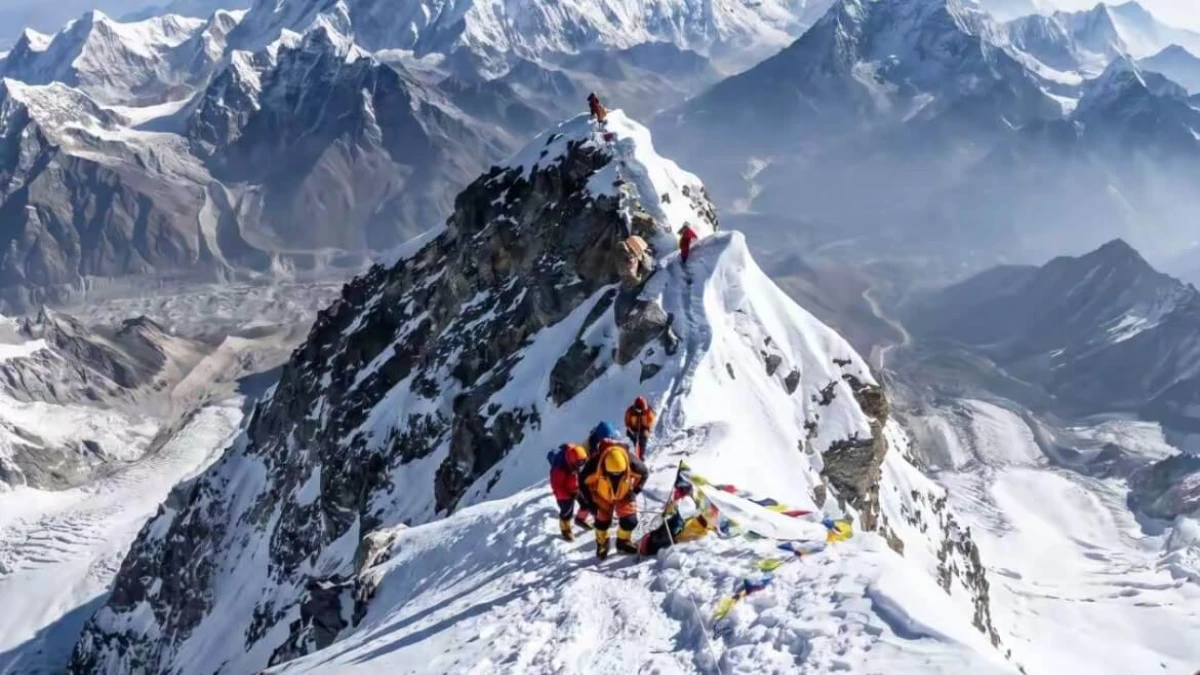
- Overcrowding in the Death Zone: So many climbers attempt Everest these days that long queues form near the summit. Standing still, waiting your turn, using up oxygen you don't have to spare. People have also died just from waiting too long in line, up there.
Sadly, hundreds of climbers have lost their lives on Everest over the years. Many bodies are still up there today, because bringing them down is too dangerous. Climbers literally walk past them, on their own way to the summit.
It's a heavy truth. The risk of climbing Mount Everest isn't small. It's real, and it's serious, every single time someone attempts it.
Is Mount Everest the Hardest Mountain to Climb?
No, Mount Everest isn’t the hardest Mountain to climb technically. A lot of serious mountaineers will tell you Everest isn't even the hardest climb out there.
- K2: This mountain is considered far harder technically. It has steeper rock, trickier climbing sections, and a much higher death rate per attempt.
- Annapurna: It is statistically one of the scariest mountains to climb, with one of the highest death rates.
- Everest: It is less technical in comparison, but brutal in other ways like altitude, length of expedition, and sheer exhaustion.
So why does Everest get all the attention of the climbers? It’s simple. It is the tallest mountain on Earth. And height alone brings its own brutal challenges, even if the climbing itself isn't the hardest, technically.
That's really the difference. Everest isn't necessarily the hardest mountain to climb, skill-wise. But it might be the hardest to survive, mentally and physically, over such a long stretch of time.
So, if someone asks, "Is Everest the hardest mountain to climb?" The honest answer is no, not technically. But it's still one of the most dangerous and most demanding, in its own way. Different mountains test different things. Everest tests patience, endurance, and how long you can survive up there. Not how well you can climb a wall of rock.
How Many People Successfully Summit Mount Everest?
Many people successfully summit Mount Everest, more than you'd probably guess. But it's still really far from easy.
Since Everest was first summited back in 1953, thousands of climbers have reached the top. Some seasons see over 600 successful summits alone, especially when the weather cooperates well.
But the number that matters more is the success rate. On average, somewhere around 60 to 70 percent of climbers who attempt Everest actually reach the summit. Sounds decent, right? Until you remember what that other 30 to 40 percent represents. Some turned back by weather, some turned back by exhaustion, and some turned back by their own bodies, simply refusing to go further.
A few things affect on who makes it and who doesnt:
- Weather windows: If you miss the short window of good weather, the summit attempt gets cancelled, no matter how ready you are.
- Physical condition: Even well-trained climbers sometimes back off, from altitude sickness or exhaustion.
- Experience level: Climbers with prior high-altitude experience tend to have noticeably higher success rates.
- Support system: Good guides, proper oxygen supply, and strong Sherpa support massively increase the odds of summiting safely.
And sadly, not everyone who attempts Everest comes back at all. Over 300 climbers have died on the mountain since records began, and that number climbs a little more, almost every single year.
So while the summit success rate looks encouraging on paper, Everest never really promises anything. Every single attempt is still a risk, no matter how experienced the climber is.
Who Should and Shouldn't Attempt to Climb Mount Everest?
Not everyone should attempt to climb Mount Everest, and thats okay to admit. Let's start with who Everest might actually be right for.
Who should consider to Climb Mount Everest?
- Climbers with real high-altitude experience already. Not just gym fitness, actual mountain experience, on peaks above at least 6,000 meters.
- People who are mentally prepared for weeks of discomfort, boredom, and fear.
- Those people in genuinely good health, with no heart or lung conditions, and cleared by a doctor familiar with altitude risks.
- People who can afford proper guides, oxygen, and safety support, because this isn’t a place to cut corners.
Who shouldn't attempt to climb Mount Everest?
- Complete beginners with zero mountaineering background. Everest isn’t a place to learn climbing basics.
- Anyone with heart conditions, asthma, or serious respiratory issues. Altitude makes these dangerous fast.
- People chasing it just for social media or bragging rights, without respecting the actual risk involved.
- Anyone unwilling to turn back if the mountain says no. Ego kills more climbers than storms do.
Can a beginner climb Mount Everest? No, a complete beginner cannot safely climb Mount Everest. Most guiding companies won't even take someone with zero high-altitude experience. It’s not impossible, but it’s just not smart, for most people.
How to Prepare for a Mount Everest Expedition
Preparation for Mount Everest cannot be just physical. It must be for almost everything.
Here’s what real preparation usually looks like:
- Build mountain fitness: Long hikes with a loaded pack, stair climbing, cardio for months.
- Get high-altitude experience: Climb smaller peaks above 6,000 meters, like some in Nepal or South America, before even considering Everest.
- Train your mind, not just your body: Practice sitting with discomfort. Take cold showers, long boring hikes, and anything that builds patience and mental toughness.
- Learn the technical skills: Learn rope work, ladder crossings, using crampons and ice axes properly. This isn’t something to learn for the first time at Base Camp.
- Plan for the mental side of waiting: Weeks will be spent just sitting around, acclimatizing. Bring books, bring patience, bring something to keep your mind occupied.
- Choose your expedition team carefully: A good guide, experienced Sherpas, and proper oxygen support can genuinely make the difference between life and death up there.
Most climbers spend a full year, sometimes more, preparing before they even set foot near Everest. That's not overkill; that's just what the mountain demands.
Is Climbing Mount Everest Worth It?
The answer depends on who you ask. If you ask someone who summited, a lot of them will say yes, without hesitation. They'll talk about the view, the silence up there, and the feeling of standing higher than anyone else on Earth, even just for a few minutes.
But if you ask someone who turned back early, or lost a friend up there, and you might get a different answer. Some say it changed them for good. Some say it took something from them they never got back.
Here's the truth though. Climbing Mount Everest isn't really about the summit photo. It's about who you become during those long, exhausting weeks leading up to it. The waiting, the fear, and the doubt at 2 am in a freezing tent. If you come out the other side of that, worth it or not almost becomes a strange question to even ask.
So is it worth it? If you respect the mountain, prepare properly, and go in with realistic expectations, most climbers will tell you, yes. But if you're just chasing a trophy, without understanding the real risk of climbing Mount Everest, it might cost you a lot more than it gives back.
Everest doesn't owe anyone a summit. It just offers the chance to try. What you make of that chance, that's entirely up to you.